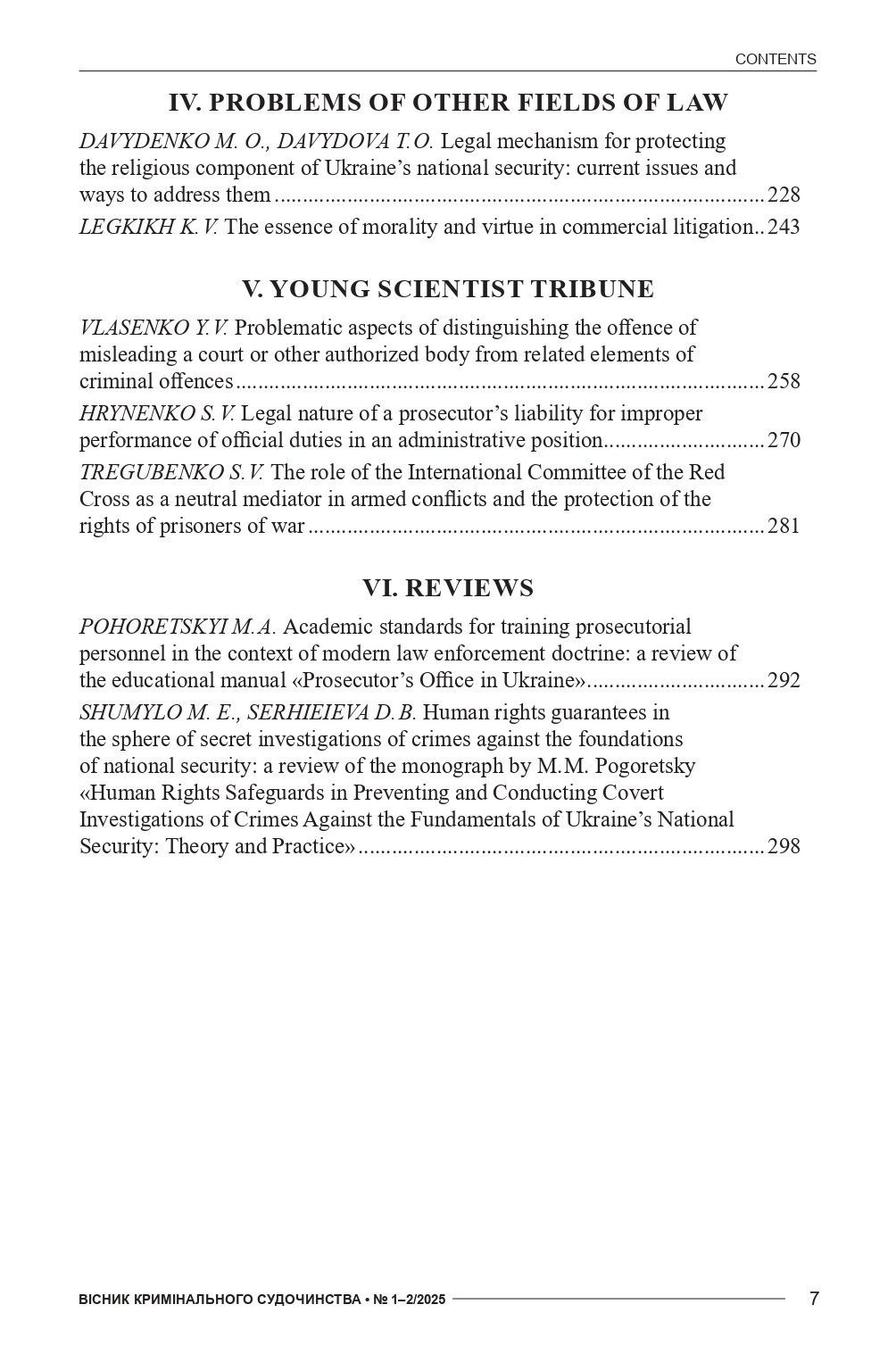
The role of the International Committee of the Red Cross as a neutral mediator in armed conflicts and the protection of the rights of prisoners of war
Pages: 281-291
Year: 2025
Location: Pravova Ednist Ltd
Дата публікації: 30.06.2025
Review
The article provides a comprehensive analysis of the role of the International Committee of the Red Cross (ICRC) as a neutral humanitarian mediator in the context of modern international and non-international armed conflicts. The international legal principles of the ICRC’s activities are revealed, which are based on the provisions of the Geneva Conventions of 1949 and their Additional Protocols, which define the Committee’s mandate to protect prisoners of war, civilians, the wounded and missing. Particular attention is paid to the principles of neutrality, humanity, impartiality and independence, which ensure a high level of international trust in the ICRC and determine its unique institutional status among other humanitarian actors.
The paper examines in detail the legal mechanisms that allow the ICRC to act as a guaranteed mediator in the processes of exchanging prisoners of war and ensuring access to places of their detention. An analysis of Common Article 3 of the Geneva Conventions, the ICRC Statute and relevant UN resolutions demonstrates that the organization has the right to independently initiate humanitarian action, conduct inspections, monitor conditions of detention and conduct confidential dialogue with the parties to the conflict. The practical effectiveness of this mandate has been confirmed by the examples of many conflicts, in particular in Ukraine, Syria, Afghanistan, Yemen, as well as within the Israeli-Arab confrontation.
The role of the ICRC in the Russian-Ukrainian war is particularly emphasized, where its mission is key to registering prisoners of war, supporting exchanges, recording violations of humanitarian law, transferring the bodies of the dead and ensuring minimum standards of humane treatment. It is emphasized that in conditions of high levels of distrust between the parties to the conflict, it is the neutral status of the ICRC that allows maintaining communication, preventing humanitarian catastrophes and documenting violations that can be taken into account in future legal procedures.
The study separately analyzes the challenges associated with the politicization of humanitarian processes, restrictions on access to detainees, information manipulation and the increase in danger for ICRC personnel. It highlights current trends in the digital transformation of humanitarian activities, in particular the introduction of secure electronic databases of prisoners of war, the latest methods of identity verification and the use of remote monitoring technologies. It emphasizes that the ICRC is gradually adapting its activities to new types of conflicts – asymmetric, hybrid and information – while maintaining the integrity of its humanitarian mandate.
It is summarized that the ICRC acts not only as an executor of humanitarian procedures, but also as a key architect of trust and a central element of the international system for the protection of war victims. It ensures the functioning of humanitarian mechanisms even in situations where state or international institutions do not have access or are not recognized as parties to the conflict. The activities of the ICRC form the basis of modern humanitarian diplomacy, ensure the preservation of human dignity in wartime, and contribute to the strengthening of international legal standards in the field of protection of persons affected by armed conflicts.