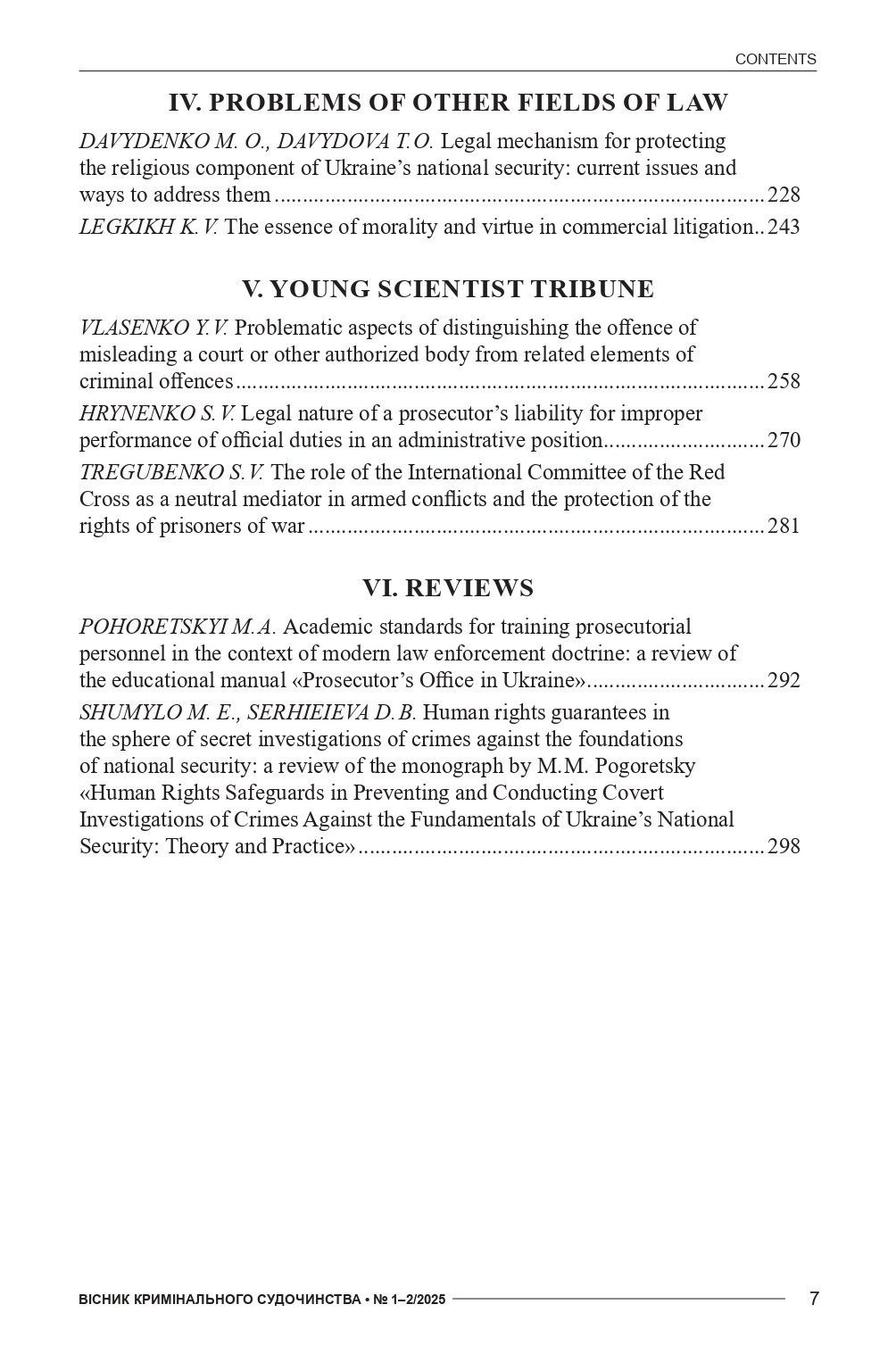
Problematic aspects of distinguishing the offence of misleading a court or other authorized body from related elements of criminal offences
Pages: 258-269
Year: 2025
Location: Pravova Ednist Ltd
Дата публікації: 30.06.2025
Review
This article provides a comprehensive analysis of problematic aspects in distinguishing the criminal offence under Article 384 of the Criminal Code of Ukraine, titled «Misleading a Court or Other Authorized Body», from other related provisions of criminal law. Particular attention is given to the relationship between Articles 358, 376, 383, and 385 of the Criminal Code of Ukraine, with a focus on the objective and subjective elements, the object of the offence, the legal nature, and the specific features of the unlawful conduct. A key emphasis is placed on delineating the boundaries of criminal liability for acts that constitute misleading a court or another authorized institution.
The purpose of the article is to conduct a comprehensive criminal law study of the differentiation between the elements of criminal offences provided in Articles 358, 376, 383, 385, and 384 of the Criminal Code of Ukraine, from the standpoint of contemporary criminal law theory, judicial practice, and in the context of upholding the principles of legal certainty, precision, and effectiveness of criminal liability. Since all of the mentioned norms involve a common mechanism of unlawful influence–namely, deception and falsification of evidence or its concealment–the issue of differentiating their legal nature, identifying their protected legal interests, scope of application, and interaction in cases of concurrence or real plurality becomes especially relevant.
The article pays particular attention to identifying both common and distinct features of deliberately false reporting of a criminal offence (Article 383 of the Criminal Code of Ukraine) and misleading a court or another authorized body (Article 384). The scholarly aim is not only to systematize the objective and subjective elements of the respective offences but also to determine the precise scope of their legal content to ensure consistent and uniform application of the law.
Within the scope of this aim, the article also explores the specific features of the subjective element of each offence, especially the notion of «deliberateness», which is pivotal for the correct criminal law qualification of such acts. This facilitates the identification of grounds for independent criminal qualification or, conversely, the exclusion of double qualification.
The study also investigates the differences between misleading a court or another authorized body (Article 384) and the refusal of a witness to testify, or refusal of an expert, specialist, or translator to perform their procedural duties (Article 385), which differ in the nature of unlawful conduct–active distortion of information versus passive evasion of procedural actions. In this context, the article explores whether these offences affect the same legally protected interest–namely, the administration of justice.
A separate objective is to analyze the relationship between Article 384 of the Criminal Code of Ukraine as a special provision and Article 358 as a general provision that establishes liability for document forgery, use, or circulation of forged documents, seals, or stamps. The aim here is to formulate practically relevant criteria for proper legal qualification when forged documents are used within judicial proceedings. This analysis also offers approaches for resolving normative competition where legal norms share the common feature of deception but differ in the content of the protected legal interest.
Thus, the overarching academic goal of the article is to substantiate theoretical and practical criteria for distinguishing between related criminal offences involving the provision of deliberately false information or evasion of procedural obligations. These criteria take into account the specificity of each criminal law provision, its functional role within the system of criminal law, and its purpose in protecting justice as a core element of the rule of law. Achieving this objective will contribute to greater accuracy and consistency in law enforcement and legal qualification.