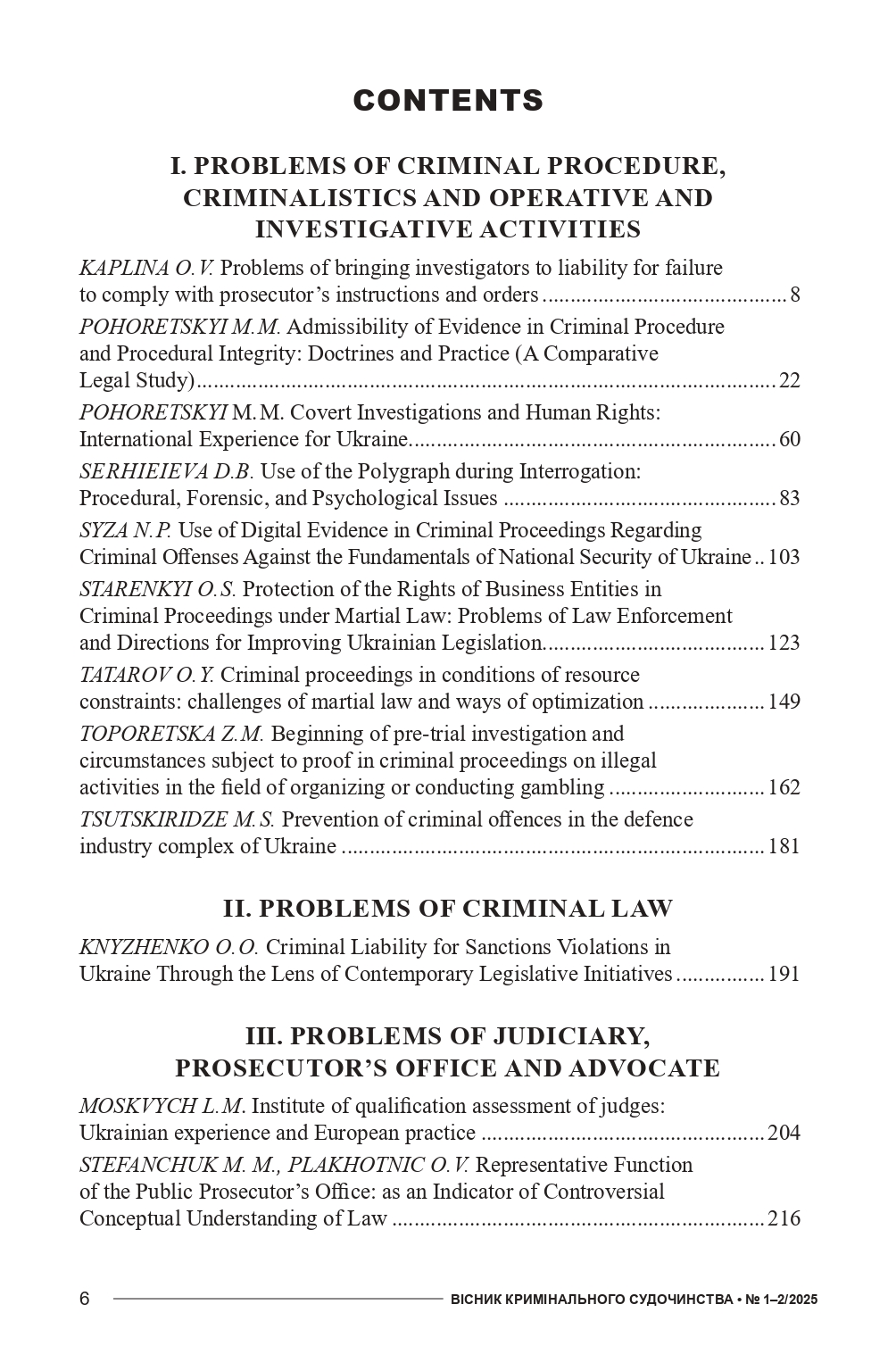
Protection of the Rights of Business Entities in Criminal Proceedings under Martial Law: Problems of Law Enforcement and Directions for Improving Ukrainian Legislation
Pages: 123-148
Year: 2025
Location: Pravova Ednist Ltd
Дата публікації: 30.06.2025
Review
Based on the analysis of scientific sources, the provisions of the current criminal procedural legislation of Ukraine, relevant legislative initiatives, certain strategic state documents, and materials of investigative and judicial practice, the article provides a comprehensive study of problematic issues of protecting the rights of business entities in criminal proceedings under martial law. It is emphasized that business serves not only as the foundation of economic viability but also as a stabilizing factor of the state in the context of hybrid threats. At the same time, Ukraine’s criminal procedural legislation contains a number of gaps and contradictions that reduce the effectiveness of law enforcement and create risks of abuse by law enforcement agencies and prosecutors.
The purpose of the article is to conduct a comprehensive analysis of the problems of protecting the rights of business entities in criminal proceedings under martial law, to assess the effectiveness of state measures in this field, and to develop scientifically grounded proposals for improving Ukraine’s criminal procedural legislation and its practical application, taking into account the needs of economic and national security.
The author applies both general scientific and special legal methods. The dialectical method is used to analyze the relationship between criminal procedural restrictions and the economic stability of the state; the formal-legal method – to interpret the provisions of the Criminal Procedure Code of Ukraine, draft laws, and decision of the National Security and Defense Council of Ukraine aimed at ensuring the protection of business rights in criminal proceedings under martial law; the systemic-structural method – to identify and systematize problematic aspects in this area; the comparative-legal method – to compare national norms with the provisions of the Convention for the Protection of Human Rights and Fundamental Freedoms and the case law of the European Court of Human Rights; the method of analysis – to identify enforcement gaps; and the method of generalization – to formulate integrated conclusions.
It is concluded that the current criminal procedural legislation of Ukraine during wartime does not provide an adequate level of protection for the rights of business entities. The key problems identified include the absence of time limits on property seizure, the imperfection of mechanisms for its storage and for ensuring business continuity in the event of asset seizure, the lack of regulation of urgent searches and their validation procedures, and the absence of effective means of responding to violations of jurisdictional rules. Such shortcomings create grounds for excessive and disproportionate state interference in entrepreneurial activity. The case law of the Supreme Court and the positions of the European Court of Human Rights clearly demonstrate the negative consequences of these legislative gaps, which restrict the real procedural guarantees for business.
It is argued that eliminating these gaps and improving criminal procedural norms is essential to minimize the risks of arbitrary interference in business, preserve economic stability, and increase trust in law enforcement agencies, prosecutors, and the judiciary. The proposed changes are of not only theoretical significance but also of considerable practical value, as they contribute to strengthening the rule of law and ensuring the protection of business entities’ rights in criminal proceedings under martial law.