- Journal Issues
- № 1-2 2025 Actual problems of criminal justice
- Problems Of Criminal Procedure, Criminalistics And Operative And Investigative Activities
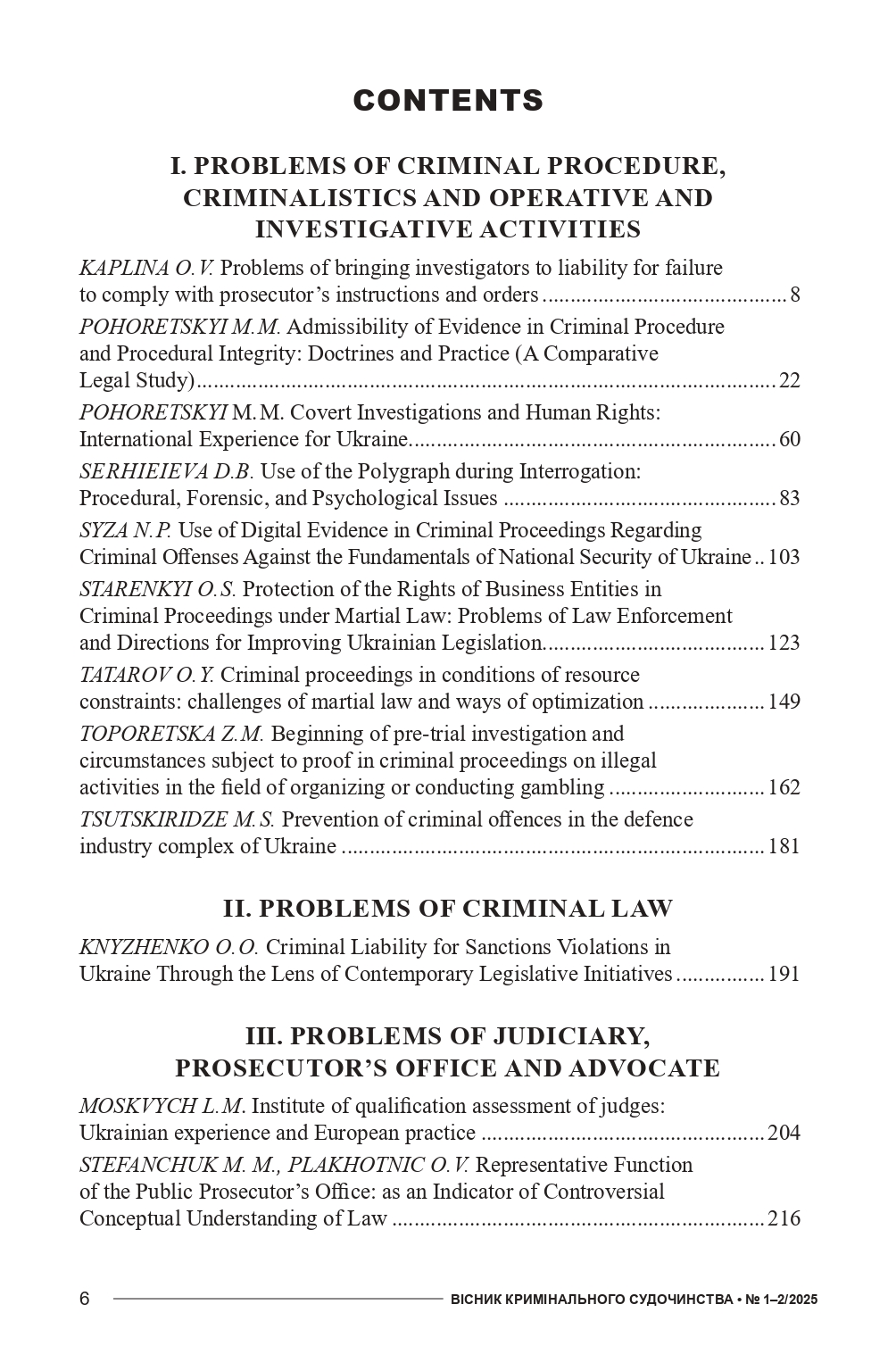
- Admissibility of Evidence in Criminal Procedure and Procedural Integrity: Doctrines and Practice (A Comparative Legal Study)
Admissibility of Evidence in Criminal Procedure and Procedural Integrity: Doctrines and Practice (A Comparative Legal Study)
Review
The article offers a comprehensive theoretical and applied analysis of the doctrine of admissibility of evidence in criminal proceedings and the concept of procedural integrity in the context of the digital transformation of the contemporary evidentiary process. Drawing on a systematic examination of classical and modern doctrinal approaches, the jurisprudence of the European Court of Human Rights (ECtHR), and a comparative analysis of the models of the United States, the United Kingdom, the European Union, and Ukraine, the study substantiates the evolution of admissibility from the formalistic understanding rooted in the Soviet tradition of «procedural correctness» to a modern, substantive model grounded in fairness, proportionality, and the effective protection of human rights. Special attention is devoted to revealing the structural elements of procedural integrity, including the legality and reliability of the evidence source, the transparency and honesty of the procedures through which evidence is obtained, the autonomy of will, the prohibition of coercion, and the good-faith behaviour of state authorities throughout the evidentiary process.
The article provides a detailed analysis of the relationship between the formal and substantive criteria of admissibility, particularly through the lens of Articles 86 and 87 of the Criminal Procedure Code of Ukraine, which reflect fundamentally different epistemological and value-based approaches to justice – from procedural legalism to the concept of substantive fairness and procedural integrity. Based on ECtHR case law (Gäfgen v. Germany, Jalloh v. Germany, Teixeira de Castro v. Portugal, Ramanauskas v. Lithuania), the study examines the standards governing the inadmissibility of evidence obtained through provocation, disproportionate or unlawful interference, or physical and psychological coercion, highlighting the substantial impact of these standards on national judicial practice.
A separate section is devoted to digital evidence, one of the most dynamic and complex categories of modern evidentiary law. The article explores the structure of digital evidence, the importance of maintaining the chain of custody, the challenges of authenticating electronic information, the use of metadata, and the risks of manipulation and technological distortion. It also analyses international forensic standards (ENFSI, NIST, Berkeley Protocol) in conjunction with doctrinal approaches developed by Mason & Seng, Kerr, Clough, Ferguson, and Schauer, emphasising the increasing need for technical reproducibility, transparency, and independent verification in digital forensics. Particular attention is given to the risks of algorithmic opacity («the black box problem») and the imperative of explainability in artificial intelligence (AI)-assisted evidentiary processes.
The article concludes by identifying key directions for the modernisation of the Ukrainian model of admissibility, including the need to develop a unified concept of «evidentiary integrity», adapt international standards of digital forensics, reform approaches to operational and digital surveillance activities, strengthen judicial oversight of technological evidentiary tools, and require transparency and accountability in algorithmic procedures. It argues that such a comprehensive approach is essential to ensure the alignment of Ukraine’s criminal justice system with the principles of the rule of law, ECtHR standards, and the demands of the digital era.
Keywords: evidence; digital evidence; toxic evidence; admissibility of evidence; procedural integrity; fair trial; digital surveillance; artificial intelligence; algorithmic risks; toxic evidence; entrapment; proportionality; judicial oversight; human rights; evidentiary integrity; chain of custody; international evidentiary standards; discretion; judicial discretion; guarantees; reasonable suspicion; sufficient ground.